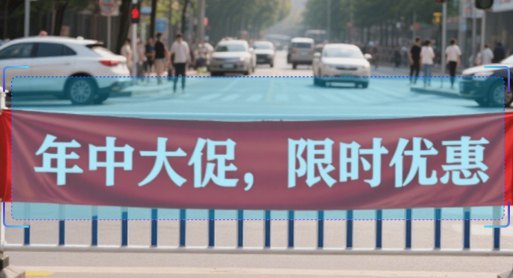
Handheld Sign Recognition


Algorithm Introduction
Capable of detecting uncivilized behavior involving handheld signs in public surveillance areas, with optimal performance in outdoor environments.
- ● Brightness requirements: The ratio of bright pixels (grayscale value >40) to total pixels in the detection area must exceed 50%
- ● Image requirements: Optimal detection at 1344×768 resolution; performance not guaranteed for video below 480p (width > height)
- ● Target size: For resolutions exceeding 1344×768, detected targets must measure ≥40 pixels (width) × 66 pixels (height)
Application Value
-

Urban Squares
Given the complex nature of crowds in public squares, the AI algorithm continuously monitor individuals carrying unauthorized banners, triggering alerts and prompting intervention to maintain order. -
Pedestrian Overpasses
Based on the high-frequency pedestrian flow characteristics of overpasses, the AI algorithm dynamically identifies individuals holding signs to prevent unauthorized promotions and safeguard the environment. -
Institutional Entrances
Focus on the patterns of personnel movement at institutional entrances to swiftly detect gatherings with inappropriate slogans, intervene promptly, and ensure operational security.
FAQ
-
Algorithm AccuracyAll algorithms published on the website claim accuracies above 90 %. However, real-world performance drops can occur for the following reasons:
(1) Poor imaging quality, such as
• Strong light, backlight, nighttime, rain, snow, or fog degrading image quality
• Low resolution, motion blur, lens contamination, compression artifacts, or sensor noise
• Targets being partially or fully occluded (common in object detection, tracking, and pose estimation)
(2) The website provides two broad classes of algorithms: general-purpose and long-tail (rare scenes, uncommon object categories, or insufficient training data). Long-tail algorithms typically exhibit weaker generalization.
(3) Accuracy is not guaranteed in boundary or extreme scenarios.
-
Deployment & InferenceWe offer multiple deployment formats—Models, Applets and SDKs.
Compatibility has been verified with more than ten domestic chip vendors, including Huawei Ascend, Iluvatar, and Denglin, ensuring full support for China-made CPUs, GPUs, and NPUs to meet high-grade IT innovation requirements.
For each hardware configuration, we select and deploy a high-accuracy model whose parameter count is optimally matched to the available compute power.
-
How to Customize an AlgorithmAll algorithms showcased on the website come with ready-to-use models and corresponding application examples. If you need further optimization or customization, choose one of the following paths:
(1) Standard Customization (highest accuracy, longer lead time)
Requirements discussion → collect valid data (≥1 000 images or ≥100 video clips from your scenario) → custom algorithm development & deployment → acceptance testing
(2) Rapid Implementation (Monolith:https://monolith.sensefoundry.cn/)
Monolith provides an intuitive, web-based interface that requires no deep AI expertise. In as little as 30 minutes you can upload data, leverage smart annotation, train, and deploy a high-performance vision model end-to-end—dramatically shortening the algorithm production cycle.